
Introduction to Ketamine’s Effects
Ketamine, originally developed in the 1960s as an anesthetic, has since emerged as a groundbreaking therapeutic agent in mental health. Known for its rapid onset and unique mechanisms, ketamine offers new hope for individuals battling treatment-resistant conditions like depression, anxiety, and PTSD. Unlike conventional antidepressants, which can take weeks to produce noticeable effects, ketamine often provides relief within hours, making it a powerful tool for addressing acute psychological distress.
The secret to ketamine’s success lies in its dual action: altering brain chemistry and inducing a state of neuroplasticity. This combination allows patients to break free from entrenched thought patterns and facilitates deeper emotional processing, particularly when integrated into a psychotherapeutic framework like Ketamine-Assisted Psychotherapy (KAP).
NMDA Receptor Antagonism
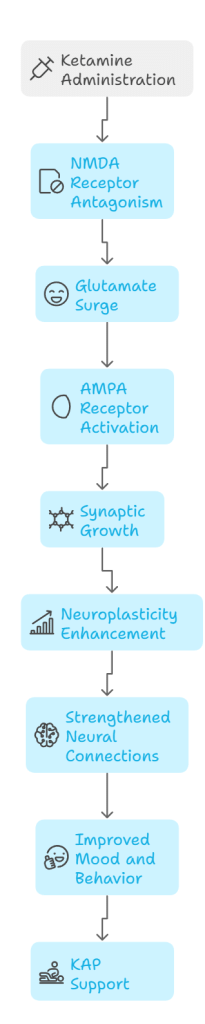
Ketamine’s primary mechanism of action involves its role as an NMDA (N-methyl-D-aspartate) receptor antagonist. These receptors play a pivotal role in the brain’s glutamate system, which regulates synaptic plasticity, learning, and memory. By blocking NMDA receptors, ketamine disrupts the overactive signaling commonly associated with conditions like depression.
This inhibition leads to a surge of glutamate release, which activates another set of receptors known as AMPA (α-amino-3-hydroxy-5-methyl-4-isoxazolepropionic acid) receptors. The activation of AMPA receptors is critical for promoting synaptic growth and the formation of new neural pathways.
To visualize this, imagine a snow-covered field where repeated behaviors and thought patterns have formed deep, well-trodden paths. Ketamine acts as a temporary “snowmelt,” enabling the brain to form new paths—representing fresh perspectives and healthier mental habits.
Role in Neuroplasticity
One of ketamine’s most transformative effects is its ability to enhance neuroplasticity—the brain’s capacity to reorganize itself by forming new neural connections. This process is essential for recovering from depression, trauma, and other mental health disorders, as it allows patients to adopt healthier ways of thinking and reacting to their environment.
Ketamine’s impact on neuroplasticity is mediated by the release of brain-derived neurotrophic factor (BDNF), a protein that supports neuron growth and survival. BDNF plays a critical role in strengthening the connections between neurons, especially in areas of the brain like the prefrontal cortex and hippocampus, which are often compromised in individuals with mood disorders.
Increased neuroplasticity means that patients undergoing KAP are not just temporarily alleviating symptoms—they are fundamentally rewiring their brains to create lasting changes in mood and behavior.
Comparisons with Traditional Antidepressants
Traditional antidepressants, such as selective serotonin reuptake inhibitors (SSRIs), work by increasing the availability of serotonin in the brain. While effective for many, these medications often take weeks or months to produce results and may fail to provide relief for individuals with treatment-resistant conditions.
In contrast, ketamine operates through an entirely different pathway—the glutamate system. By directly targeting NMDA receptors and facilitating AMPA receptor activation, ketamine produces a cascade of neurochemical changes that result in rapid symptom relief.
Additionally, traditional antidepressants focus on modulating existing neural pathways, whereas ketamine promotes the creation of entirely new connections. This distinction explains why ketamine can be so effective for individuals who have not responded to conventional therapies.
Furthermore, the experiential aspects of ketamine therapy, such as altered states of consciousness, provide opportunities for profound psychological insights that complement its neurobiological effects—a dimension absent in traditional antidepressant treatments.
Patient-Friendly Explanations of Brain Changes During KAP
Understanding how ketamine works can empower patients to fully engage in their therapeutic journey. Here’s a simplified explanation:
The brain is like a densely packed forest of trees (neurons), with pathways (synapses) connecting different areas. Over time, stress, trauma, or depression can create overgrown and rigid paths, limiting how information flows. Ketamine acts as a “reset button,” pruning the overgrowth and allowing new, flexible paths to form. This “rewiring” not only improves mood but also opens the door to new ways of thinking and relating to the world.
During KAP sessions, patients often experience a state of dissociation, characterized by a sense of detachment from their usual thoughts and feelings. This altered state allows them to view their experiences from a different perspective, gaining insights that are difficult to access in a typical mental state. After the session, psychotherapy helps patients process these insights and integrate them into their daily lives, solidifying the changes initiated by ketamine.
Ketamine’s revolutionary mechanisms—NMDA receptor antagonism and neuroplasticity enhancement—set it apart from traditional treatments for mental health disorders. By targeting the brain’s glutamate system, ketamine not only provides rapid relief but also fosters long-term changes in how patients think, feel, and behave.
In the context of KAP, these biological effects are amplified by the therapeutic process, creating a holistic approach to healing that addresses both the mind and brain. As research continues to uncover new facets of ketamine’s potential, its role in mental health care is likely to expand, offering hope to those who have struggled for far too long.
For individuals seeking a transformative approach to mental health, understanding the science behind ketamine can be the first step toward embracing its life-changing benefits. Whether as a standalone treatment or as part of an integrative therapy like KAP, ketamine offers a beacon of hope in the evolving landscape of mental health care.